
X Money and Its 6% APY
A review of X Money and the risks of banking at fintechs

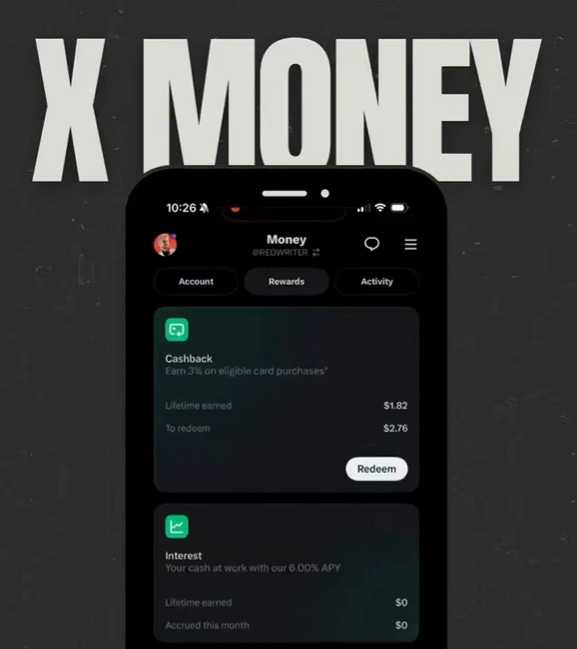
Since Elon Musk took over Twitter in 2022, he renamed it to X and has been migrating it into an “everything app.” The latest addition to X is a bank account called X Money. Like many financial technology companies (fintechs), X has partnered with an FDIC-insured bank, Cross River Bank, to hold the deposits.
X Money recently transitioned into a high-profile beta testing phase with William Shatner helping to attract X members as beta testers. To become an X Money beta tester, X members had to place a $1,000 bid in Shatner’s charity auction. In addition to the publicity of becoming an early customer of X Money, beta testers might also be interested in some very attractive banking perks. The two big ones are a 6% APY and a cash-back debit card that earns 3% on most purchases. Based on beta tester reports, there appears to be no balance caps on the 6% APY and no activity requirements (like direct deposit).
These X Money perks are clearly promotional to attract publicity. As X Money becomes publicly available, I’m sure the APY and the cash-back percentage will fall inline with other fintech competitors. One of those fintech competitors is Revolut, which also partners with Cross River Bank. Its high-yield savings account currently pays 5.50% APY, but only up to $10,000. The APY falls to 3.75% for larger balances.
If Elon Musk is really determined to grow X Money and decides to maintain the 6% APY for many months, would it be worthwhile to open an X Money account when it becomes publicly available? One important issue with X Money is that it’s not a bank. It’s acting as a middleman between depositors and Cross River Bank. Even though deposits might be FDIC insured once they’re at Cross River Bank, it still has more risk than if you bank directly with an FDIC-insured bank, like Ally or Marcus. A disturbing example of what can happen when you bank through a non-bank fintech recently happened.
Lost Fintech Deposits, the Synapse/Evolve/Yotta Debacle
A November 2024 CNBC article by Hugh Son described how thousands of Americans lost their savings due to banking at Yotta, Juno and other fintechs. The article mostly focused on former customers of the fintech Yotta which provided a sweepstake savings feature. Yotta customers felt their savings were safe since Yotta advertised that deposits were FDIC-insured through Evolve Bank & Trust. Below is an excerpt from Yotta’s homepage on January 27, 2022 as saved by the Internet Archive:
“Funds are held with Evolve Bank & Trust, Member FDIC.”
Unfortunately, their deposits were not safe. It was not just Yotta and Evolve Bank that handled deposits. Another fintech, Synapse Financial Technologies, was being used to keep track of the deposits. In February 7, 2024, Yotta’s homepage (per Internet Archive) showed more banking partners and confusing relationships:
“Your money is held in an account eligible for pass-through FDIC insurance up to $250,000 through Evolve Bank & Trust, member FDIC, Thread Bank; Members FDIC and Synapse Brokerage LLC Program Banks.”
After Synapse went bankrupt in April 2024, Evolve and other banks froze access to accounts associated with Synapse due to issues with the Synapse ledgers. According to this WSJ article, “roughly 116,000 accounts were affected across all banks.” The fintechs like Yotta, the fintech Synapse and the banks were blaming each other for the ledger problems.
Interviews of several of the Yotta victims were included in the CNBC article. Here’s an excerpt of one victim’s story:
For 15 years, former Texas schoolteacher Kayla Morris put every dollar she could save into a home for her growing family.
When she and her husband sold the house last year, they stowed away the proceeds, $282,153.87, in what they thought of as a safe place — an account at the savings startup Yotta held at a real bank.
[...]
“We were informed last Monday that Evolve was only going to pay us $500 out of that $280,000,” Morris said during a court hearing last week, her voice wavering. “It’s just devastating.”
Most victims are still waiting for the return of their savings. In December 2025, the Fintech Business Weekly reported that the Consumer Financial Protection Bureau “allocated $46 Million to the Synapse/Evolve victims.” The timeline when the victims will receive these funds is unclear.
With such a terrible fintech banking failure, many might wonder how anyone can trust a fintech to be their bank. I’ve been told that it’s unfair to compare X Money’s partner, Cross River Bank, with Synapse. The problem is that many Yotta customers opened accounts when it appeared to be just Yotta and an FDIC-insured bank. The banking relationships became more complex and the risk grew until the funds were frozen and essentially lost.
Customer Service Worries
If you believe that Elon Musk will ensure X Money remains safe and sound, there’s another potential issue to consider. Can you trust X Money’s customer service? In recent years, the accounts of many X members have been taken over by hackers, and it hasn’t been easy for these members to regain control over their accounts. The well-known financial planner and friend of mine, Allan Roth, had his X account stolen in 2023. He described his ordeal in this X post:
“I haven’t Tweeted for a while because my account was stolen as part of a mass breach of users. Not many people left at Twitter and I only got a response after sending a FedEx to a Twitter senior attorney.”
This type of bad customer service history doesn’t instill confidence in the use of X as a bank to hold your deposits.
Future of X Money
The 6% APY and 3% cash back may not be enough to offset the risks of banking at a fintech. Since these rates are promotional with no guarantees about how long they may last, it doesn’t seem worthwhile to jump on X Money once it’s open to all Americans.
One thing may improve. A surge of fintechs have recently been applying for banking charters. These include PayPal, Revolut and Affirm. They may follow the path of fintechs like Varo and SoFi that went from a non-bank fintech to an FDIC-insured bank. If X Money follows this path, opening an X Money account would be just like opening an account at Ally Bank. While it remains a fintech, it’s hard to trust X Money to be as safe as a bank.
Credit to @REDWRITER for the X Money Image.
I’m one of the 1000’s who trusted Juno when they told us our deposits were FDIC insured without ever mentioning synapse in any of their advertising. Never use Fintech. There are plenty of banks and credit unions offering good and SAFE rates!